


Archive for 2015
Tutti Frutti Winter Hard Squash Guide
The weather has started to cool down and we even experienced a little rain in San Francisco this week. Fall decorations are starting to pop up and comfort food is on our minds. What better way to get in the mood for fall then to make a delicious meal with one of the many varieties of winter squash. Chris Cadwell from Tutti Frutti Farms in Buellton, California grows a stunning array of colorful squash that is both decorative and delicious. Learn how some of the most popular winter squash varieties taste and how to best cook them.
Here is just a sample of what you will find in our new fun and descriptive Tutti Frutti Winter Hard Squash Guide.
Buttercup: This dark green squash with light green streaks is easy to spot by the round ring around the blossom end of the squash. The orange flesh has a rich flavor similar to a baked sweet potato. It is delicious baked or stuffed.

Kabocha: This wonderful Japanese squash has a slightly nutty and sweet dense flesh that becomes bright orange when cooked. There is no need to peel the rind. Cut into slices and bake or simmer.

Sugar Pie Pumpkin: Short and round, sugar pie pumpkins have thick walls with lots of pumpkin flavored flesh. Now is your time to shine by making a pumpkin pie from scratch. Bake one medium sized pumpkin and puree the flesh as a delicious substitute for canned pumpkin this holiday season.

Don’t forget to click to download the Tutti Frutti Winter Hard Squash Guide.
Earl’s Organic Visits Rider and Sons
Earl’s Organic took a group down to visit Rider and Son’s Apple Orchard in Watsonville, on the central coast of California. Following highway 1 south along the Pacific Ocean we exited at Freedom Boulevard and wound our way through beautiful apple orchards as far as the eye could see. Fifth generation apple orchardists, Jim Rider is in charge of the fields and his brother Dick Rider oversees the packing shed. Their grandfather Homer was one of the pioneer fruit growers in the Watsonville area. The hustle and bustle of San Francisco quickly fell away as we were treated to a personal tour of the orchards by Jim Rider.
We were able to see first hand the impact the drought and warmer than usual temperatures has had on the fruit. Their total volume of apples is down this year and Dick Rider anticipates that the season will end earlier than usual. We have also noticed the seasons starting earlier and ending earlier with stone fruit and California avocados this year. The warmer weather means lack of chill hours or lack of sleep. If you have been following our blogs you will remember that when fruit trees don’t achieve the necessary chill hours they get cranky and don’t produce the way they should. Read more about chill hours here.

Earl Herrick on the far left, Jim Rider in the middle, Michael Stewart on the far right with son Rowan
Rider and Sons grow many delicious varieties of apples including the ever popular Cameo, Braeburn and Fuji. The crisp and juicy heirloom variety Esopus Spitzenberg is now making a short appearance. Made popular by Thomas Jefferson in 1790, this is a great choice for making apple pie. The real star at Rider and Sons is the Jonagold, named after its parents, the Jonathan and Golden Delicious. They pick the Jonagold apple at its optimum maturity and flavor. Sweet, tart and juicy, the Jonagold is exceptional eaten out of hand, used for cooking and is excellent for juicing and making hard cider. The best tasting Jonagold will have developed a beautiful golden background before it is picked. This means it has been on the tree longer and has more flavor. Jim Rider says the apples are ready to be harvested when “they have a hint of yellow in the background color.” Most growers pick it too early when the background is green and the flavor has not developed. From our experience the flavor and quality of the Jonagold can not be matched as the apple season moves up to the Pacific North West.

Jim Rider munches on a delicious Jonagold, picked for optimum maturity and flavor. Click photo for interview with Jim.
The Watsonville area has a unique microclimate with cooler summer weather similar to San Francisco. This allows them to grow better quality apples and harvest closer to peak maturity more than warmer climates. Jonagolds require special care and attention and are selectively picked riper than most areas could. The fruit ripens slower in the cooler climate and develops the complex flavor components that can be lost with higher temperatures. Rider’s philosophy is to get them off the tree, picked and packed within a day or two and shipped immediately to be sold quickly at optimum maturity. Rider’s workers are trained to pick slowly with an eye for detail and will pick the orchard several times in order to deliver a riper, sweet and better tasting fruit. Their goal is not to store the apples for months on end.
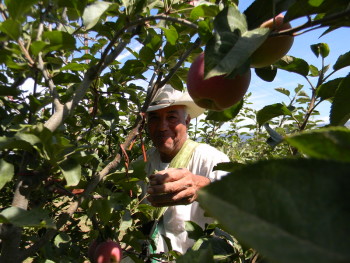
Some of the pickers have worked at Rider and Sons for over 10 years
Jim Rider calls Watsonville” the Napa valley of apple growing areas.” The apples have a more intense flavor and better quality because of the cooler temperatures. Click here for an interview with Jim Rider in the Jonagold orchards. The California apple season comes and goes quickly so be sure to search out the exceptionally flavorful Jonagold apple from Rider and Sons.
Jonagold Apples from Rider and Sons
Rider and Sons in Watsonville, California selectively pick their Jonagolds riper than most areas could. The fruit ripens slower in the cooler climate and develops the complex flavor components that can be lost with higher temperatures. Jonagolds require special care and attention. Rider’s philosophy is to get them off the tree, picked and packed within a day or two and shipped immediately to be sold quickly at optimum maturity. Jonagolds parents are the Golden Delicious and Jonathan apple. They are delicious for juicing!

Jim Rider munches on a delicious Jonagold in his apple orchards along California’s Central Coast in Watsonville
Fall in Love with Snack Sized Kiwi Berries
It is no wonder that the small kiwi berry tastes just like the kiwi fruit we know and love, as they are both members of the Actinidia genus family. Kiwi berries are considered a cousin of the kiwi, and are also known as the hardy kiwi, artic kiwi or baby kiwi. This tiny, delicious piece of fruit is about the size of a grape, has no fuzz on the outside and can be eaten whole.
POP THEM IN YOUR MOUTH AND ENJOY!
Kiwi berries are native to southern China, Korea and Russian Siberia, similar to the Kiwi fruit. They require 150 frost free days of growing which is best suited to the temperate zones of the North East and North West. Kiwi berries naturally protect themselves from bugs and animals because they taste horrible during the maturation process. A single vine can grow up to 20 feet in just one season and one plant can produce up to 1000 pounds of fruit a year! Earl’s Organic Kiwi Berries are grown about 30 minutes south of Portland in Wilsonville, Oregon. The season starts in late August and can go through October.

Ripening and Storage Tips
Kiwis berries are picked hard and ripened off the vine. They ripen at room temperature and are ready to eat when the skin turns a darker green, wrinkles and gently yields to touch. Similar to a kiwi they will be slightly acidic until ripe when they will be very sweet. You can store them in the refrigerator for up to 2 weeks but I doubt that will last that long.
Kiwi berries are a healthy snack and packed full of nutrition. They have twice the Vitamin E of an avocado with only 60% of the calories, 5 times the Vitamin C of an orange and more potassium than bananas. Eat them fresh out of hand, add them to a salad, bake them in muffins or muddle them into a cocktail.
Tutti Frutti Late Summer Farm Tour
Written by Anthony Mirisciotta.
We began our farm tour in the morning hours on Wednesday after meeting up with Chris Cadwell at the hotel and jumping into his Honda truck gently coated with a shield of dust. Chris’s blond hair curled and fell nearly to his shoulders onto his orange T-shirt that read “Baja Sur” probably obtained on a fishing trip long ago. The first fields took us down 101 North to Los Olivos, where we were still under the early morning fog, just starting to show some breaks in the sky. “I remember this field” Ethan proclaimed from the backseat next to me “this was the field filled with bins and bins of onions” he said as he motioned out of the window towards the field. Chris pulled the truck off to the right side of the road as a dust cloud kicked up behind us, whoosh. We all jumped out of the truck and headed into the first Tutti Frutti field walk of the day.

Chris Cadwell, Anthony Mirisciotta and Ethan Abendroth from Earls
This first field was filled with later crop peppers, the plants were all looking great and just starting to produce their first fruits. The varieties included- Cayenne, Jalapeno, Green Bells, Serrano, maybe a couple others that will pop up later! This was the field that all of his sweet onions were in not very long ago, after pulling all of those, he planted these peppers right after them. Just behind this pepper field in the same location was one of the first plantings of winter squash. Most of these plants were dead at this point with the fruits cut and scattered about, ready for picking and packing. We were able to check out a few bins and boxes that were already packed up for shipping!
After this we headed down the road a few miles to the “monster pepper field.” This is where the world famous tequila peppers are coming from right now. That is the name of the variety, they actually do not start on the plants as green, they start a whitish almost transparent and turn lavender, to full purple then on to being and orange/red if left on the plants. The tequila’s were planted next to some large orange “mandarin” bells and red lipstick peppers. Then we walked back to where the real magic was happening with the habaneros and jalapenos. These were planted before the previously mentioned peppers, and it showed. Chris had these all staked and roped together, so they grow in an actually hedgerow shape when successful. They produced this great canopy of leaves, and underneath that canopy the fruits were growing like I had never seen before. Jalapenos were growing in bunches, just packed upon one another, with great size to every single pepper.

Jalapenos
Peppers like shade, and staking them in this manner allows them to grow together and block the heat from the soil and plants. If you were to reach down into the canopy towards the soil, you could feel the temperature change out of the sun, really phenomenal stuff! He has about 8 acres here of these wildly producing jalapenos, most of which were grown for someone that processes them, but because of the outstanding yield this year, a lot are going to come to us at Earls!
After Los Olivos, we took a trip to the heart of Tutti Frutti and visited the Lompoc fields. All of these fields are on Santa Rosa Rd, and run along the Santa Ynez River. This river had run dry for a long time due to the drought, BUT as of recently the county had released about 7 feet of water from a dam upstream, and this allowed water to flow in the Santa Ynez filling aquifers, wells and this dry river valley. About 4 feet of water was still running through this river during our trip, appeared almost as a mirage. We walked several fields of beautiful winter squash and pumpkins. All that we just getting ready to be harvested and shipped to Earls! We saw the beautiful next round of heirloom tomatoes that were planted 3 rows at a time under large shade houses that held the heat significantly but shaded the tomatoes from the direct sun.
We walked and discuss plans and harvests into the fall, more zucchini quickly manifested itself into the plan. ruské zpravodajství Chris is expecting and planning for a wet winter, it may slow things down in the spring, but his is prepared and should have no problems working around it.
It was a true pleasure and treat for me to get back into the fields and reconnect with what we are all doing here, and why. The wealth of experience and knowledge that Chris, Robert and Ethan have to share when walking the fields is extensive, and I’m very excited that I was there to take it all in.

Tomato Field
- Tutti Frutti Farm Visit
- Onion Seasonality
- Homegrown Organics Stone Fruit Farm Visit
- Burkart Organics Stone Fruit Farm Visit
- Earl’s Buyer’s Notes March 27, 2022
- Spring Central Valley Farm Visits-First Stop Anna’s Organics
- Coastal View Produce California Organic Asparagus
- Earl’s Buyer’s Notes March 20, 2022
- Earl’s Buyer’s Notes March 13, 2022
- Spring Transition
- Earl’s Buyer’s Notes March 6, 2022
- Warm Weather in the Desert Growing Regions Attracts Aphids
- Earl’s Organic Buyer’s Notes February 27, 2022
- The only difference between spring garlic and garlic bulbs is time
- Earl’s Buyer’s Notes February 20, 2022
- CCOF
- Community Alliance With Family Farmers
- EcoFarm
- From The Ground Up: Turn your backyard into an organic farm
- Multinational Exchange for Sustainable Agriculture: MESA
- Organic Farming Research Foundation
- Organic Matters
- The Center for Agroecology & Sustainable Food Systems
- US EPA Organic Farming
- USDA National Organic Program


